
Toyota’s “Walk Me” Robotic Chair: A Crab-Inspired Mobility and Accessibility Revolution
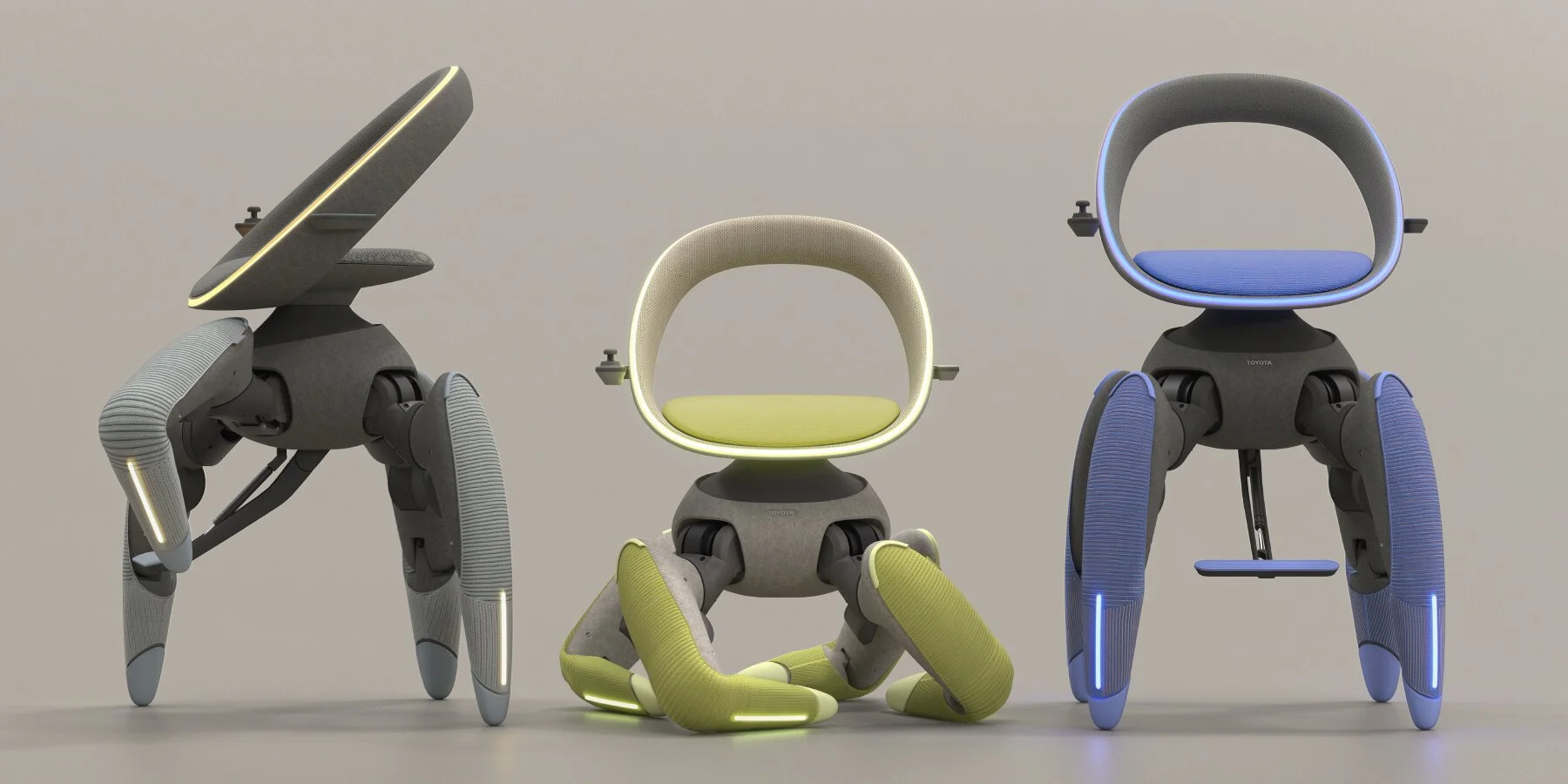
Three futuristic Toyota “Walk Me” mobility robots with soft, fabric-covered bodies and flexible leg-like supports sit side by side, each outlined with glowing light accents in different colors, showcasing a concept design for assisted personal mobility.
Summary
Engineers have unveiled a prototype robotic chair that moves not on wheels, but on articulated legs, allowing it to step over obstacles, climb stairs, and assist users with tasks like getting into a car. While still conceptual, the design highlights how robotics could address everyday mobility challenges that conventional wheelchairs cannot.
What Was Introduced?
The device, presented as a concept at a major mobility and robotics showcase, resembles a seated platform mounted on four mechanical legs. Rather than rolling across flat surfaces, the chair “walks,” using coordinated leg movements to navigate uneven ground, thresholds, and stairs.
The chair is designed to carry a seated person through indoor environments and transitional spaces, such as doorways, curbs, and steps, areas that often limit independence for people who rely on wheeled mobility aids.
How the Chair Works
Instead of wheels, the chair uses multiple jointed legs that can lift, lower, and stabilize the seat in real time. Sensors embedded in the system allow it to detect obstacles and adjust its gait accordingly.
Key demonstrated capabilities include:
Stepping up and down stairs
Maintaining balance on uneven flooring
Raising or lowering the seat to assist transfers, such as entering a vehicle
The chair can be controlled manually, and developers suggest future versions could incorporate greater autonomy.
Why This Matters for Mobility
Traditional wheelchairs work well on smooth, accessible surfaces, but struggle in homes and cities that were not designed with universal access in mind. Stairs, narrow thresholds, and uneven terrain remain major barriers.
A legged mobility device addresses a different problem than speed or efficiency. Its value lies in adaptability, the ability to move through environments as they already exist, rather than requiring those environments to be redesigned.
If such systems become practical, they could reduce reliance on caregivers for specific physical transitions, even if they never replace wheelchairs entirely.
How This Differs From Existing Mobility Aids
Most advanced mobility devices today focus on:
Improved wheels and suspension
Powered exoskeletons worn by the user
Smart wheelchairs with navigation assistance
This concept takes another approach: separating mobility from the user’s body entirely and placing the mechanical complexity in the chair itself. The goal is not to restore walking, but to replicate the functional advantages of legs.
What Still Needs to Be Solved
The chair remains a prototype, and several challenges stand between concept and real-world use:
Ensuring long-term safety and stability with a seated human
Managing size, weight, and power requirements
Making the system affordable and practical for everyday environments
At present, the chair serves more as a proof of concept than a deployable solution.
Why This Matters Beyond One Device
This project reflects a broader trend in assistive technology: moving beyond incremental improvements and exploring fundamentally different ways to solve accessibility problems.
Rather than asking users to adapt to fixed environments, or forcing environments to adapt perfectly, engineers are beginning to design machines that can flexibly bridge the gap between the two.
Bottom Line
A walking robotic chair may seem unconventional, but it addresses a real limitation of current mobility aids. While still experimental, the concept suggests a future in which mobility support is less constrained by stairs, thresholds, and uneven spaces, and more focused on meeting people where they are.
Sources & Further Reading
Live Science: Bizarre robotic chair concept looks like a crab and can carry you around the house — it can even help you into your car
Electronics360 (GlobalSpec): Toyota announces robot chair that walks, climbs and folds itself
Designboom: Toyota’s autonomous wheelchair with foldable legs can climb stairs
Interesting Engineering: Walk Me: Toyota stuns world with robot chair that walks, climbs, and folds itself
My Modern Met: Toyota Designs Robot Chair That Can Walk, Bend, and Help You up the Stairs