
A Donor Kidney Is Converted to a Universal Blood Type and Successfully Transplanted
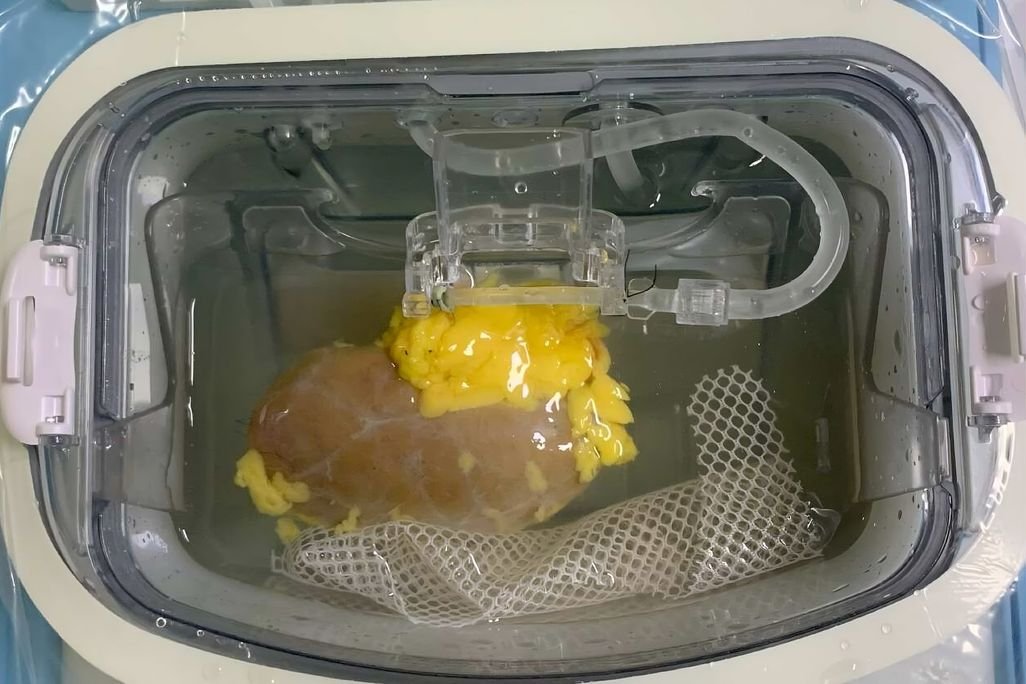
Photograph of a human kidney placed inside a clear, sealed plastic chamber filled with liquid. Tubes are connected to the kidney, circulating fluid through it, while yellow fatty tissue is visible on the surface of the organ. The setup shows a kidney undergoing a laboratory perfusion process, which researchers use to treat, preserve, or modify donor organs before transplantation.
Summary
In a world first, researchers have shown that a donor kidney can be altered so it no longer carries a specific blood type, a change that could eventually allow more people to receive transplants, regardless of their blood group. While still experimental, this breakthrough points to a future where fewer organs go unused and fewer patients wait years for a life-saving kidney.
What Happened in This Study?
Blood type is one of the biggest barriers in organ transplantation. A kidney from a person with blood type A can usually be given only to recipients with compatible blood types. In this study, scientists tried something new: they changed the kidney itself.
Using specially designed enzymes, researchers removed blood-type A markers from a donor kidney, effectively turning it into a type O kidney — the universal donor type. The organ was then transplanted into a person who had been declared brain-dead, allowing doctors to safely observe how the human immune system responded.
For the first two days after transplant:
The kidney functioned normally
Blood flow was healthy
There were no signs of immediate rejection
After several days, some blood-type A markers began to reappear, showing that the technique still needs refinement.
Why Blood Type Is Such a Big Deal
People with type O blood can receive kidneys only from type O donors. Everyone else has more options. As a result:
Type O patients often wait the longest for transplants
Many viable kidneys can’t be used for certain recipients
The transplant system struggles to balance fairness and efficiency
If kidneys could reliably be converted to type O, far more donor organs could be matched to waiting patients — especially those who currently have the fewest options.
How This Is Different From Today’s Workarounds
Doctors already perform some transplants across blood types, but doing so requires aggressive treatments to suppress the recipient’s immune system. These approaches:
Increase infection risk
Add cost and complexity
Aren’t available at all transplant centers
This new method takes a different approach: instead of forcing the patient’s body to adapt to the organ, it adapts the organ to the patient.
What Still Needs to Be Solved
This research is an early proof of concept, not a ready-to-use therapy. Key challenges remain:
Making the blood-type change last permanently
Ensuring long-term safety in living transplant recipients
Scaling the process so it can be used routinely in hospitals
The use of a brain-dead recipient highlights both the care taken in testing this idea — and how far it still is from everyday clinical practice.
Why This Matters Beyond One Kidney
This study reflects a broader shift in transplantation: moving from managing scarcity to engineering compatibility. If organ modification techniques continue to advance, they could:
Reduce transplant wait times
Improve equity in organ allocation
Help health systems make better use of donated organs
Bottom Line
Scientists have shown that changing a kidney’s blood type is possible — and that the organ can function normally, at least in the short term. While many hurdles remain, this work offers a glimpse of a future where blood type no longer determines who gets a transplant and who keeps waiting.
Sources & Further Reading
Nature Biomedical Engineering: First human transplant of a kidney modified to have a “universal” blood type
National Library of Medicine (NIH): Enzymatic blood group antigen removal: preclinical and mechanistic background
Scientific American: Scientists perform first-of-its-kind transplant using kidney with a converted blood type
Reuters: Health Rounds: Scientists change kidney blood type, a potential advance for transplant recipients
Smithsonian Magazine: Scientists converted a kidney’s blood type, then implanted it into a brain-dead patient