
Microscopic Robots Are Being Designed to Deliver Drugs Directly Inside Living Cells
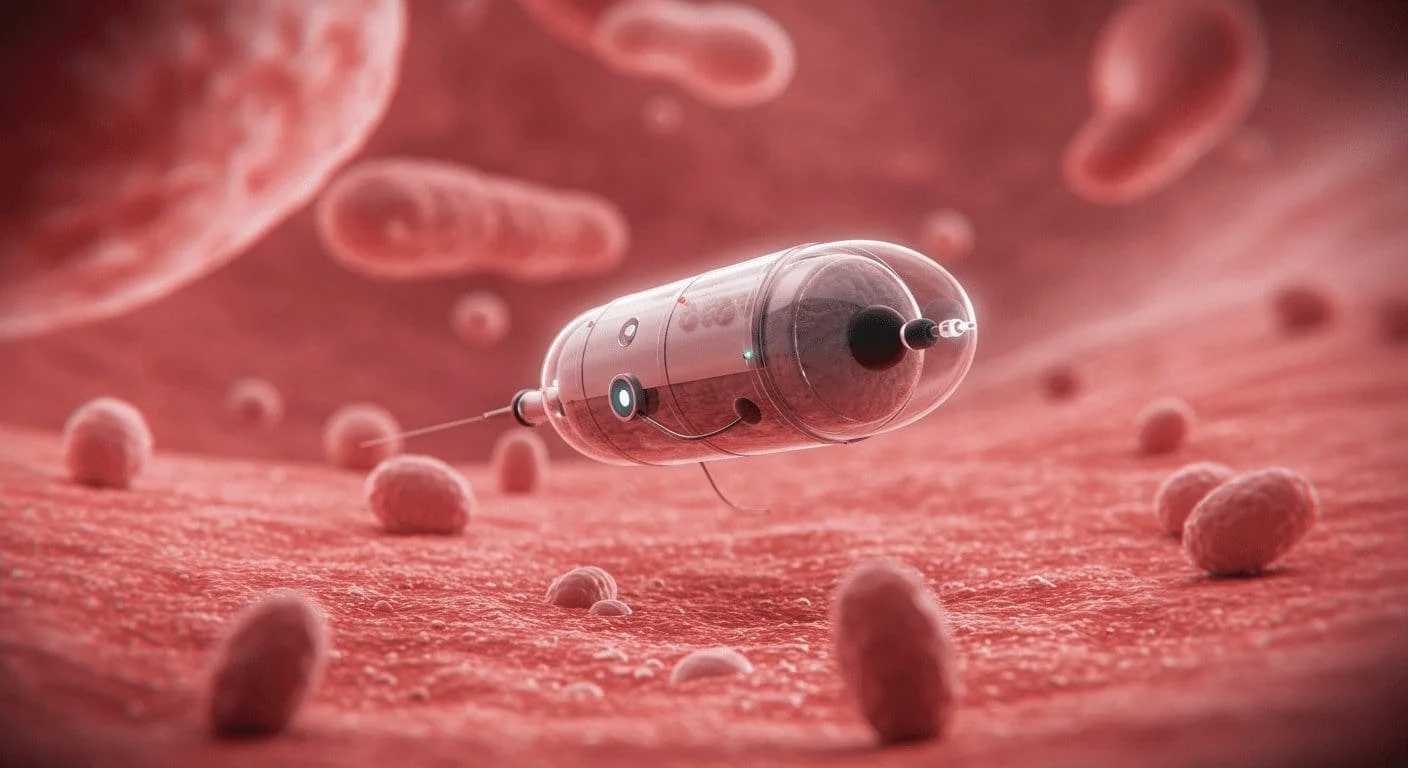
Most strong medicines spread through the body the way a sprinkler waters a yard. The plants that need water get it. So do the sidewalk and the weeds. In medicine, that extra spread becomes side effects. That spillover is expensive. Whole body side effects are tied to roughly one third of drug failures in clinical trials.
So the goal is drip irrigation. Aim the dose at the root. Spare the landscape of the body from harm. The frontier of magnetically guided microrobots are doing just that.
The basic idea
Build a carrier so small it can travel through vessels, then give it two powers:
It can be pulled and steered by magnets outside the body
It can release its drug only when it reaches the target
Instead of dumping medicine into the bloodstream and hoping enough reaches the right place, you move the medicine to the place first.
What these microrobots look like in clinically aimed designs
One clinically oriented platform uses three parts:
Electromagnetic navigation system: generates controllable magnetic fields to steer the capsule.
Catheter delivery: places the capsule into the correct vessel or fluid pathway near the target.
Dissolvable drug capsule: spherical, soluble gel shell loaded with medication, containing iron oxide nanoparticles (magnetic response) and tantalum nanoparticles (visible on X ray).
What they can carry
In research demonstrations, capsules have been loaded with very different drugs, including:
A clot dissolving agent
An antibiotic
A tumor drug
That matters because it shows the delivery system is meant to be versatile.
How steering works in a living body
Blood does not flow like water in a straight hose. It surges, forks, and accelerates through narrow turns. Two steering strategies show up in early work:
Rolling the capsule along the vessel wall using a rotating magnetic field, with reported speeds around 4 millimetres per second
Pulling the capsule using magnetic field gradients, reported to work even against flow velocities over 20 centimetres per second
In early results, the capsule reached the intended target location in more than 95 percent of cases.
How the drug gets released & Timing
Arrival is step one. The capsule has to open at the right time.
One approach works like a heat-shrink seal. A high-frequency magnetic field makes the iron-oxide particles warm up. That warming melts or dissolves the gel shell, and the drug spills out at the target.
Other “open the capsule” methods are basically different triggers:
Chemistry trigger: the capsule material is built to loosen or break in a certain environment, like an acidic area. Example: over 48 hours, 78.9% of the drug released at pH 5.5 versus 45.9% at pH 7.4.
Light trigger: a light sensitive coating cracks or changes shape when hit with a specific light wavelength.
Sound trigger: focused ultrasound shakes or stresses the capsule until it opens or dumps its cargo.
The common idea: the carrier stays closed while traveling, then a chosen trigger makes it open on purpose where the treatment is needed.
How doctors track something this small
Steering only works if doctors can see where the capsule is in real time. Different “cameras” can be used, depending on where the capsule is and what it’s made of.
Ultrasound: uses sound waves to create a live image. It’s the same type of tech used in pregnancy scans. It’s fast, safe, and good for seeing soft tissue, but tiny objects can be hard to spot unless they’re designed to stand out.
Photoacoustic imaging: a hybrid method. A laser pulse hits tissue, and anything that absorbs that light gives off a tiny sound wave. An ultrasound sensor picks up that sound and builds an image. The benefit is that certain materials and blood-rich areas can show up with higher contrast than ultrasound alone.
X ray and fluoroscopy: X ray takes a picture. Fluoroscopy is basically live X ray video, often used during procedures to guide catheters. If the capsule contains an X ray–visible material, it can be watched as it moves.
MRI: uses strong magnets and radio waves to map the inside of the body with high detail. It’s great for soft tissue contrast and can track some magnetic materials, but it’s slower and more complex to use during active navigation.
Many robot types, one mission
There is no single microrobot blueprint because the body isn’t one kind of terrain.
Some are corkscrews that spin forward like bacteria.
Some are tiny capsules that roll along a vessel wall like a balled up roly-poly.
Some are like earthworms in wet soil, built for tight turns.
Some act like ticks that latch and hold position. Others move like bee swarms, many particles behaving like one.
And some are biohybrids, meaning they borrow natural materials so the body doesn’t treat them like a foreign object. It’s like wrapping the carrier in the body’s own “mulch” so it blends in, or pairing it with tiny living swimmers that move like pond algae..
What this means for the general public
If this becomes routine care, it changes a basic tradeoff in medicine. Right now, the dose is often capped because the drug irritates healthy organs while it travels through the body. Targeted delivery tries to send more of the drug to the problem spot first, so less of the body gets hit on the way. The earliest real-world uses are easiest to picture when the target is clear and specific, like a clot, a localized infection, or a tumor.
Why transplant and autoimmune patients care
These are not short courses of medicine. These are long seasons of it.
Transplant:
Immune suppressing drugs protect the organ
Whole body immune suppression raises risks like infection, certain cancers, and organ toxicity
Autoimmune disease:The immune system attacks specific tissues
The medicine still spreads everywhere
Targeted delivery aims to concentrate the effect where the immune conflict is hottest, while lowering exposure elsewhere.
What still stands in the way
This is hard for reasons that have nothing to do with imagination and everything to do with physics and safety:
Control drops in real blood flow
Clumping or blockage must be prevented
Biocompatibility and breakdown must be predictable
Release timing must be precise
Manufacturing must scale with consistent quality
Regulatory standards treat this like a device and a drug delivery system, because it is both
Bottom line
Sprinklers are effective. They are also messy.
Magnetically guided microrobots are an attempt to deliver medicine like drip irrigation:
Move the dose to the target
Release it on cue
Leave less medicine roaming the body looking for places to cause troubleWhat is still hard
This is not a straight pipe and a simple magnet. Key hurdles keep showing up across reviews:
Strong, changing fluid flow that reduces control in real vessels
Biocompatibility and biodegradability that must be predictable, every time
Release timing that must be precise, not “close enough”
Imaging plus navigation plus delivery in one package, without adding new risks
Manufacturing at medical grade scale, with tight quality control
Regulatory proof that the device and the drug delivery behave safely in humans
The possibility for the future
The next leap in medicine is not only new drugs. It is smarter delivery of the drugs already in use. If targeting keeps proving safe and useful in people, healthcare shifts from managing side effects to preventing them. Doses can be set by what the disease needs, not by what the rest of the body can tolerate. That is a future with fewer complications, fewer add on medications, fewer hospital trips, and treatments people can stay on long enough to actually benefit.
Follow this research to stay in the know
Stay up to date on magnetically guided microrobots and targeted drug delivery. These links let you subscribe once and receive updates automatically.
➡️ Follow New Studies (Auto-Updating Feed): PubMed RSS feed for microrobot + targeted drug delivery research.
➡️ Get Email Alerts (PubMed Topic Alerts): Create email alerts when new papers are published on this exact topic.
➡️ Follow the Research on Google Scholar: Get email notifications when new papers cite or expand this work.
(These resources do not replace medical care or clinical trial enrollment. They are for staying informed about research as it develops)
Sources & Further Reading
Science: Clinically Ready Magnetic Microrobots for Targeted Therapies
Nature Reviews Drug Discovery: Magnetic microrobots provide targeted drug delivery
MDPI / Molecules: Magnetic Microrobots for Drug Delivery: A Review
National Library of Medicine (PubMed): Magnetically Guided Microrobots for Targeted Drug Delivery
EurekAlert!: Magnetically guided micro- and nanorobots for targeted drug delivery