
How We’re Getting the Immune System Over Its Beef With Pig Kidneys
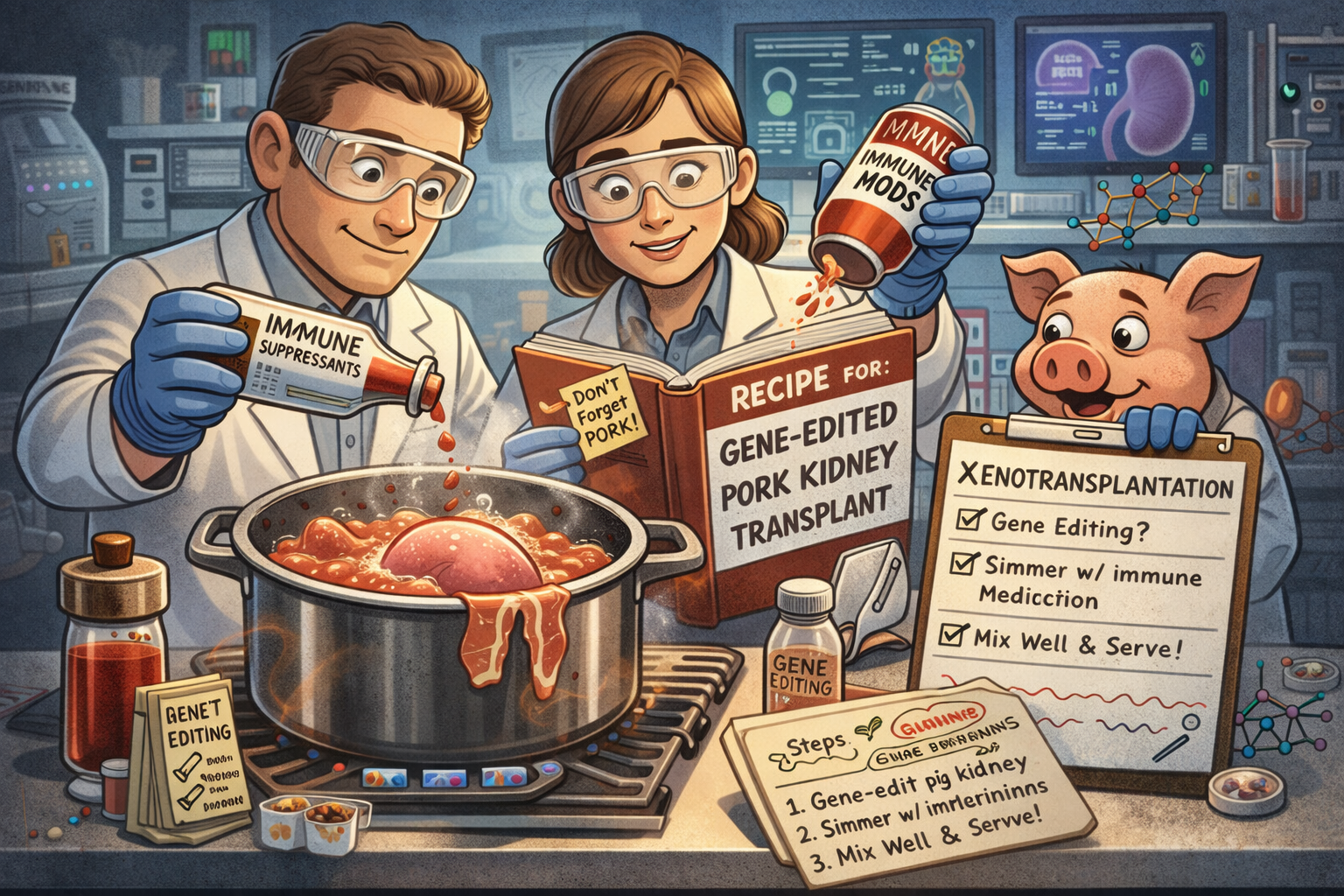
Let’s be honest: the organ transplant waitlist is the worst dinner reservation in the world. The price of the table is your health, the wait feels endless, and the host at the door (your immune system) is impossibly strict about who gets seated. For years, scientists have had the ingredients for a solution sitting on the counter. But every time they tried to bring a pig kidney to the table, the immune system took one look and said, “Sorry, you’re not on the list,” and showed it right back out.
For years, scientists have been teasing a solution that sounds like science fiction: Xenotransplantation. That’s the fancy medical term for taking an organ from an animal (specifically, a gene-edited pig) and putting it into a human.
It sounds great on paper. Pigs are plentiful, their organs are roughly the right size, and we’re already pretty good at gene editing. But there’s always been one massive, glaring problem: The human immune system looks at a pig kidney, screams “STRANGER DANGER,” and nukes it.
Until now.
Researchers at NYU Langone Health just dropped a bombshell study that doesn't just show that rejection happens—it explains exactly how it happens, and more importantly, how to stop it.
If you’re waiting for a kidney, or just love seeing medical boundaries get pushed, here’s why this is a very big deal.
The NYU Langone Study: 61 Days of Discovery
First, let’s set the scene. This wasn’t a standard clinical trial. The researchers transplanted a gene-edited pig kidney into a human decedent (a person who had passed away, but whose body was donated to science and maintained on a ventilator).
This allowed the team to take biopsies and blood samples at a frequency you simply couldn’t do with a living patient. They watched that kidney like a hawk for 61 days.
What they found (The "Detailed Map")
They didn't just see rejection; they mapped it out. They identified three specific waves of attacks launched by the immune system:
Antibodies: The immune system's "taggers" that mark the organ for destruction.
Macrophages: The "eaters" that try to engulf foreign invaders.
T Cells: The specialized "assassins" that hunt down specific targets.
The Plot Twist
Here is the part that should make you sit up straight and say, “Say what?!”
When they saw these immune tantrums starting, they didn't just watch the kidney fail. They used FDA-approved immunosuppressive drugs (the stuff we already have in pharmacies) to calm the immune system down.
The result? They successfully reversed the rejection. No permanent damage. The kidney kept working.
Key Takeaway: We used to think pig kidney rejection was an unstoppable freight train. This study proves it’s more like a leaky faucet—if you have the right wrench, you can fix it.
It’s Not Just Decedents: Success in the Living
While the NYU study gave us the mechanical "how-to," other research is proving this works in living, breathing humans.
A recent paper published in Nature Medicine tracked the first living recipient of a gene-edited pig kidney. They used something called donor-derived cell-free DNA (dd-cfDNA).
Think of dd-cfDNA as "litter." When cells in a transplanted organ get damaged or die (which happens during rejection), they spill their DNA into the recipient's bloodstream. By measuring the amount of "pig DNA" floating around in the human's blood, doctors could tell if rejection was starting days before the kidney actually started to struggle.
Why this matters for you:
Imagine getting a simple blood test that tells your doctor, "Hey, the immune system is getting suspicious," allowing them to adjust your meds before you even feel sick. That’s the future these biomarkers are building.
Breaking Records: The 130-Day Milestone
You might be wondering, "Okay, but how long do these things actually last?"
We are moving past the days of "it worked for 50 hours." We are now looking at months.
Take the case of Towana Looney. She received a gene-edited pig kidney and lived with it for 130 days—that’s over four months of freedom from dialysis. While the kidney was eventually removed due to rejection complications (linked to an unrelated infection that forced doctors to lower her meds), 130 days is a massive leap forward.
It proves that a pig kidney can do the job of a human kidney for a significant stretch of time. For a dialysis patient, four months of freedom is a lifetime.
The FDA Says "Go"
Perhaps the most exciting update isn't happening in a lab, but in a boardroom. The FDA has officially green-lit clinical trials for gene-edited pig kidneys.
This moves xenotransplantation from "experimental, compassionate use only" to "structured clinical trials." It means:
More patients will get access.
Data will be standardized.
We are inching closer to this being a standard treatment option, not a headline-grabbing anomaly.
The Immune System 101: Why Is It Such a Hater?
To understand why this is hard, you have to respect the bouncer that is your immune system. It has two main security teams:
1. The Innate Immune System (The Bouncer)
This is the security guard at the door checking IDs. If it sees something it doesn't recognize (like a pig cell), it attacks immediately. It’s not specific; it’s just aggressive.
2. The Adaptive Immune System (The SWAT Team)
These are the T-cells and B-cells. They learn. Once they recognize a specific enemy, they build a memory of it and launch a targeted, massive attack.
Gene Editing is the Fake ID
The pig kidneys used in these transplants aren't just barnyard organs. They are gene-edited. Scientists remove the genes that make the pig cells look "pig-like" (sugars that act like neon signs saying "I DON'T BELONG HERE") and add human genes to help the organ blend in.
It’s like giving the pig kidney a fake mustache and a pair of glasses so the bouncer lets it into the club. The NYU study shows that even with the disguise, the bouncer eventually gets suspicious—but now we know how to bribe him.
What This Means For You (How to Get the Pork Meatball Rolling)
If you or a loved one is navigating kidney disease, it’s easy to get cynical about "breakthroughs." But this feels different. Here is the reality check:
Short Term: If you are in a trial, doctors now have better tools (biomarkers) to keep that kidney safe.
Medium Term: We are seeing proof that rejection can be reversed. That turns a "failed transplant" into a "manageable complication."
Long Term: The goal is to turn the organ shortage into a history lesson. Imagine a world where you don't wait for a donor to die; you just schedule your transplant.
We haven’t written the cookbook yet. But for the first time in history, we’ve got the basic ingredients in the stock pot. We have a recipe in the making.
Learn More (Sources)
NYU Langone Health: Immune reactions found behind human rejection of transplanted pig kidneys
Nature Medicine: Immune profiling in a living human recipient