
PKD Meet Your Kryptonite: A Tiny RNA Blasting Cysts from the Inside
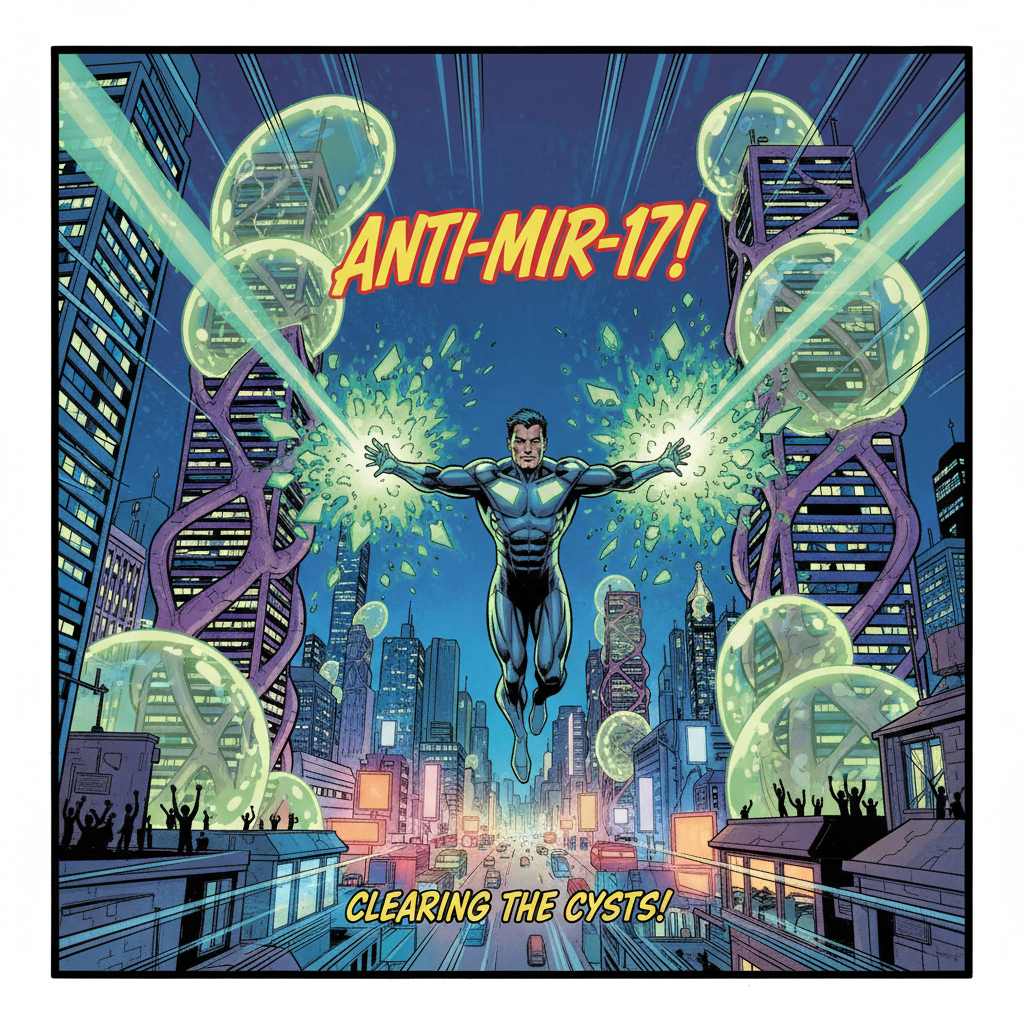
Picture your kidneys as Metropolis—a bustling hub where everything runs like clockwork. Power plants hum, communication networks fire perfectly, and the whole system keeps you alive without you even thinking about it.
Now imagine Lex Luthor moved in and started building skyscrapers everywhere. Except these aren't skyscrapers—they're fluid-filled cysts. And instead of a skyline, you've got kidneys that look like they've been invaded by bubble wrap.
Welcome to polycystic kidney disease, or PKD. It's basically the villain origin story nobody asked for.
In its most common form (autosomal dominant polycystic kidney disease, or ADPKD), these cysts multiply like Bizarro clones. Year after year, they expand and crowd out the healthy tissue that's desperately trying to keep your filtration system running. Eventually, for many people, the whole operation shuts down and kidney failure swoops in like Doomsday on a bad day.
For decades, doctors have been playing defense—managing blood pressure, treating infections, and doing damage control. It's helpful, sure. But it's also like Clark Kent frantically using his freeze breath on a fire while the arsonist is still standing there with a flamethrower.
Now? Scientists are finally going after the arsonist.
Meet the Tiny Tyrant Inside Your Cells (Spoiler: It's Not Mxyzptlk)
Deep inside every cell in your body, there's a high-stakes conversation happening 24/7. Think of it like the Justice League communicating through their headsets: "Build this protein!" "Stop dividing!" "Power down for maintenance!"
One of the key players in this cellular chatter is something called microRNA—specifically, a troublemaker named miR-17.
If your DNA is the Daily Planet's printing press (writing the big stories), then microRNA is Perry White deciding which stories make the front page and how loud the headlines scream. They don't create the instructions, but they sure control the volume.
Here's the problem: in ADPKD, miR-17 has gone full General Zod. It's cranked the volume to maximum and is barking orders that nobody should be following:
"Multiply faster!" (Cells start dividing like they're trying to win a speed-dating contest.)
"Mess up the power grid!" (Your cellular energy metabolism goes haywire.)
"Build more cysts, NOW!" (Because apparently, one wasn't enough.)
In short, this microscopic menace is stomping on the gas pedal of disease progression. So scientists asked the obvious question: What if we could just take away its bullhorn?
Enter the Hero: Anti-miR-17 (AKA Kryptonite for Cyst Growth)
Cue the dramatic music. Here comes anti-miR-17—a specially designed RNA molecule with one job: find the loudmouth miR-17, latch onto it like Jimmy Olsen clinging to Superman's cape, and shut it down.
This isn't some blunt-force Hulk smash. It's a precision strike. Think Batman with a plan, not the Joker with explosives. Anti-miR-17 doesn't wreck the whole system—it just turns down the volume on the one signal causing all the chaos.
And when researchers tested this molecular hero (called RGLS4326, for those keeping score) in preclinical models of ADPKD? The results were straight out of a comic book victory montage:
✅ Cyst growth slowed down like someone finally hit the brakes on a runaway train.
✅ Kidney enlargement was put on pause—no more Incredible Hulk-sized organs.
✅ Overall kidney structure looked healthier, like Metropolis after Superman cleans up the wreckage.
✅ Disease-driving pathways dialed back to normal levels, restoring order to the cellular Justice League.
Even better? This drug was designed to be kidney-specific. It's like a heat-seeking missile programmed to go straight to the source of the problem, concentrating its superpowers where they're needed most. No collateral damage in Gotham. No mess in Smallville. Just targeted, precise action in the kidneys.
That said, early testing did reveal some kryptonite of its own—at high doses, RGLS4326 caused off-target effects in the nervous system (specifically messing with a brain receptor called AMPA-R). Scientists didn't throw in the towel, though. They went back to the lab and created a next-generation version (RGLS8429) that has the same cyst-fighting power but skips the side effects. That's currently in human trials.
Because even superheroes need a software update sometimes.
Why This Is a Bigger Deal Than Lois Lane Getting Her Pulitzer
Most PKD treatments are reactive. They're the cleanup crew arriving after Lex Luthor has already blown up half the city. They manage symptoms, ease the damage, and keep you functional—but they're not stopping the villain.
This new approach? It's proactive. It goes "upstream" to target the evil mastermind before the destruction even starts.
This is part of a seismic shift happening across medicine. Instead of just asking, "How do we mop up the mess?" we're now asking, "Which instruction got corrupted, and can we rewrite it before everything goes sideways?"
And this isn't science fiction set in the year 3025. RNA-based medicines are already FDA-approved and saving lives in other diseases. Seeing this kind of molecular precision applied to PKD? That's the moment when the PKD community realizes this disease isn't an unstoppable Phantom Zone sentence. It's a biological process we can actually mess with.
Let's Keep Our Feet on the Ground (Even If We're Wearing Red Boots)
Before anyone gets too excited and tries to leap tall buildings in a single bound, let's be clear:
❌ This is not a cure.
❌ This is not available at your pharmacy tomorrow.
❌ It still has to pass rigorous human trials to prove it's safe and effective over the long haul.
But here's what it does mean: PKD is no longer an inevitable countdown to kidney failure. Scientists are finally targeting the disease at its biological roots with tools built for precision, not brute force.
The goal? Give people more years with their own working kidneys. Reduce complications. Push dialysis and transplant further down the timeline—maybe even off the board entirely for some.
It's about turning a sprint toward kidney failure into a slow walk. Giving people more time to live their lives without a villain breathing down their necks.
And honestly? That's a mission even Superman would be proud of.
Sources:
Nature Communications: Discovery and preclinical evaluation of anti-miR-17 oligonucleotide RGLS4326 for the treatment of polycystic kidney disease
Kidney International (Wiley): MicroRNA-17 family promotes polycystic kidney disease progression
Frontiers in Physiology: Non-coding RNAs as potential biomarkers and therapeutic targets in polycystic kidney disease
Genes (MDPI): Exploring the therapeutic significance of microRNAs in kidney disease
Journal of Clinical Medicine (MDPI): MicroRNAs in Kidney Diseases: Pathophysiology, Biomarkers, and Therapeutic Potentials
This article is for education only and does not replace medical advice. Always talk with your healthcare team about diagnosis, treatment options, and clinical trials.